Holy Monday

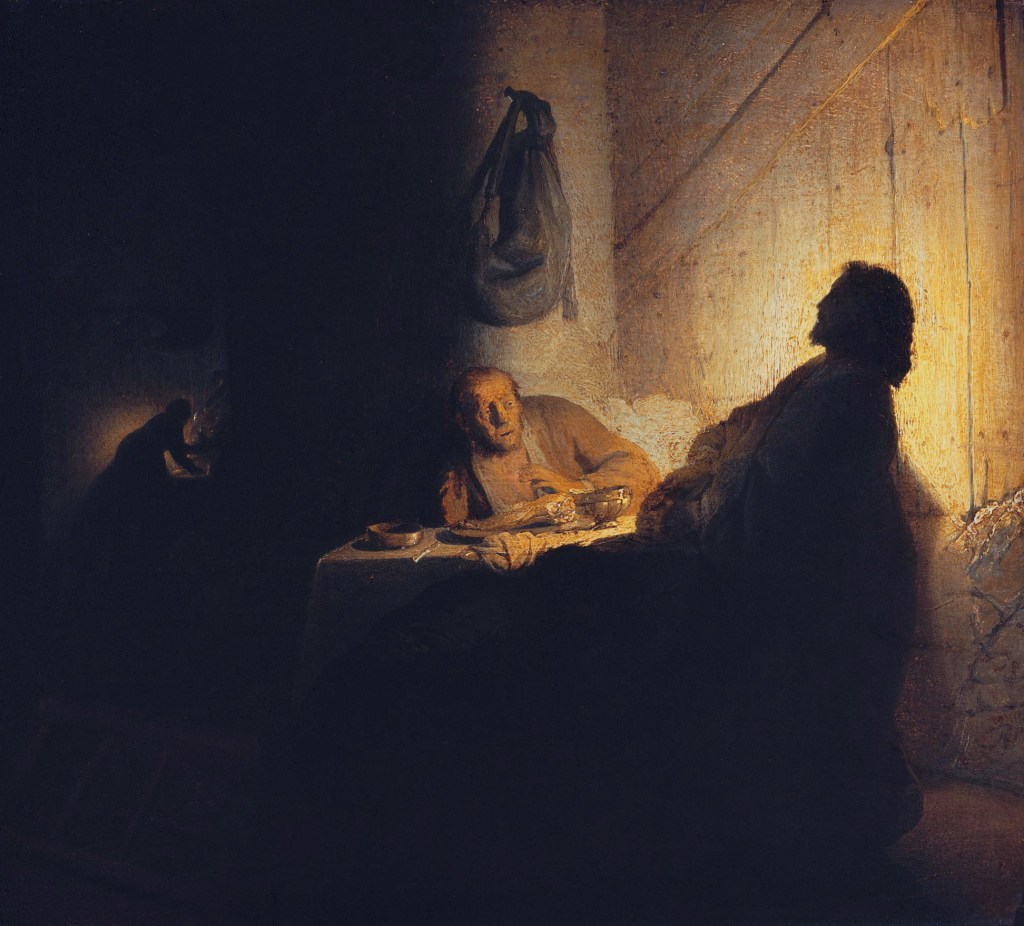
Rembrandt_Christ_Driving_The_Money_Changers_From_The_Temple

(Cross-posted at Image of Truth)

On Monday, Jesus, after cursing a fig tree for not producing fruit (thus establishing his authority over the created world) re-enters Jerusalem and raises quite the ruckus in the temple.

When they arrived back in Jerusalem, Jesus entered the Temple and began to drive out the people buying and selling animals for sacrifices. He knocked over the tables of the money changers and the chairs of those selling doves, and he stopped everyone from using the Temple as a marketplace. He said to them,“The Scriptures declare, ‘My Temple will be called a house of prayer for all nations,’ but you have turned it into a den of thieves.”

When the leading priests and teachers of religious law heard what Jesus had done, they began planning how to kill him. But they were afraid of him because the people were so amazed at his teaching.

That evening Jesus and the disciples left the city. (Mark 11:15-19 NLT)

Some interpreters have turned this passage into a diatribe against capitalism, particularly in some artistic portrayals. Modernized Passion plays have portrayed the temple courts as everything from a flea market to Wall Street. However, capitalism itself is not what Jesus is rebuking. Those selling in the temple courts were taking advantage of pilgrims who came to Jerusalem to offer sacrifices. They would change out Roman currency for temple currency at exorbitant  exchange rates, then sell clean animals to be offered as sacrifices by those who had not brought their own animals. The temple merchants were taking advantage of people… and in the very temple of God. The courts had become a cesspool of dishonesty and greed, and Jesus would have none of it. Those who portray Jesus as a mere docile, nonabrasive figure must ignore this passage, where his righteous anger overflows into violence.

(Illustration: Rembrandt, Christ Drives the Money Changers Out of the Temple, 1626)

Palm Sunday

Christs_Entry_into_Jerusalem_Hippolyte_Flandrin_1842

(Cross-posted at Image of Truth)

Palm Sunday beings Passion Week (or Holy Week). The primary event the day commemorates is Jesus’ ride into Jerusalem on the Sunday before he was crucified. The work pictured, Christ’s Entry into Jerusalem by Jean-Hippolyte Flanderin, is one of a minority of painting to portray a certain uniqueness in Matthew’s telling of the triumphal entry. Matthew alone says that Jesus used two donkeys, not one, in his ride into Jerusalem:

As they approached Jerusalem and came to Bethphage on the Mount of Olives, Jesus sent two disciples, saying to them, “Go to the village ahead of you, and at once you will find a donkey tied there, with her colt by her. Untie them and bring them to me. If anyone says anything to you, say that the Lord needs them, and he will send them right away.”This took place to fulfill what was spoken through the prophet:“Say to Daughter Zion,

‘See, your king comes to you, gentle and riding on a donkey, and on a colt, the foal of a donkey.’”

The disciples went and did as Jesus had instructed them. 7 They brought the donkey and the colt and placed their cloaks on them for Jesus to sit on. A very large crowd spread their cloaks on the road, while others cut branches from the trees and spread them on the road. The crowds that went ahead of him and those that followed shouted,“Hosanna to the Son of David!”“Blessed is he who comes in the name of the Lord!”“Hosanna in the highest heaven!”  (Matt. 21:1-6)

The other gospels do not include this detail. However Matthew, who focuses on Jesus most as Jewish Messiah, is careful to include it. Meanwhile, the scene features a word that we often confuse or misinterpret today.  Hosanna was not merely a praise, as it is often used today, but also a cry for salvation. The crowds were, as Jesus entered Jersualem, praising and proclaiming him the Messiah that would save Israel once and for all. When this did not happen in the way they believed it would, they turned on him just a few days later. Yet, in doing so, salvation was brought in the way that the Messiah did intend… his own death and resurrection.

The Hosanna from the gospels has been set to music many times, in many styles. Sojourn Music has a setting of it on their album Advent Songs (with Christmas-themed lyrics, however we at Sojourn traditionally sing an alternate set of lyrics to the same melody on Palm Sunday). Well-known musical theatre composer Andrew Lloyd Webber has composed two Hosannas, one for the controversial rock opera Jesus Christ Superstar in 1970 and another, using the Vulgate translation of Mark 11:9, in his highly stylized Requiem Mass in 1984. This version is show below in its first live performance.

(Illustration: Jean-Hippolyte Flanderin, Christ’s Entry into Jerusalem, 1842)

Apocryphal Fun

maccabee1

It was announced this week that Mel Gibson is set to produce and possibly direct a film based on the story of the apocryphal books of 1st and 2nd Maccabees. Despite some of his remarks and personal problems in recent years, Gibson remains one of the few directors I would trust to maintain the epic and moving atmosphere of the original, as is his violent but emotion-driven style. Having particularly loved the chronicles of Maccabees for some time, I thought I might share a favorite sequence that would make for an interesting scene on film: the bungled suicide of Razis. Continue reading

The King James Bible as Literary Milestone

KingJamesBible1612-1613

This month marks the 400th anniversary of the publication of the Authorized Version of the Bible, commonly called the King James Version. Being criticized today as outdated in both common language and scholarship (both of which are based in truth), it is easy to forget what an enormous impact the King James Bible and the tradition of translations in the century before, all based on the original translation work of William Tyndale, had on the English language that we speak to this very day. Only the works of William Shakespeare hold the slightest candle to the King James Bible as a primary hammer in shaping the early, molten Modern English language.

I, myself, have only in very recent years come to a greater appreciation of the King James Bible. Fortunately, the 400th anniversary celebration has given us quite a selection of resources on this most important of translations and the force it has played in both literature and theology.

St. Helen’s Church Bishopsgate has provided this remarkable short introduction to the King James Bible:

A Short History of the KJV from St Helen’s Church on Vimeo.

Three websites have emerged as great resources for learning about the King James.

The King James Bible Trust is a British-based website featuring a completely readable facsimile of a 1611 King James Bible, a YouTube program of people (some notable) reading favorite passages from the King James, and numerous resources for churches, communities, and schools about the King James.

KJV400 is the site organized largely by Thomas Nelson Publishers, currently the leading publisher of KJV bibles in the world. It has several significant features, including a complete, readable facsimile of a 1611 edition.  It also features an impressive four-part documentary on the history of the King James Bible which goes into a bit more depth than the St. Helen’s Bishopgate video, if one has the time.

Finally, for an Australian contribution, ABC Religion & Ethics has put together an impressive page of articles, videos, and audio regarding the KJV, including scholars, both religious and literary, worldwide.

There are a few other notable resources, too. To see an example just how many phrases the King James Bible introduced into the English language, see The Kings English and this page from The Phrase Finder. However, if you would like a more immediate, and more fun, demonstration, watch the below video:

Lastly, a terrific documentary has been released to video, KJB: The Book That Changed the World from Lionsgate Films and hosted by the insurmountable John Rhys-Davies. Here is the trailer:

Pascha

jesus-resurrection1

He is risen! (He is risen indeed!)

The resurrection of Christ, which we celebrate today, is the integral focal point of all redemption history. Christ, who had died for the sins of the world on Friday, is on Sunday brought back to life in his glorified body. The New Creation has broken into the present, and Christ inaugurates this world of new life, for “Christ has indeed been raised from the dead, the firstfruits of those who have fallen asleep.  For since death came through a man, the resurrection of the dead comes also through a man” (1 Cor. 15:20-21).   Indeed, if we are Christians, then the present reality that the New Creation has broken into the present creation through Christ”Therefore, if anyone is in Christ, the new creation has come: The old has gone, the new is here!” (1 Cor. 5:17)

Dr. N.T. Wright has a wonderful reflection particularly fitting for today in his book Surprised by Hope:

The resurrection of Jesus offers itself, to the student of history or science no less than the Christian or theologian, not as an odd event within the world as it is but as the utterly characteristic, prototypical, and foundational event within the world as it has begun to be. It is not an absurd event within the old world but the symbol and starting point of the new world. The claim advanced by Christianity is of that magnitude: Jesus of Nazareth ushers in not simply a new religious possibility, not simply a new ethic or a new way of salvation, but a new creation….
We could cope – the world could cope – with a Jesus who ultimately remains a wonderful idea inside his disciples; minds and heart. The world cannot cope with a Jesus who comes out of the tomb, who inaugurates God’s new creation right in the middle of the old one.

[Quote HT]

(Illustration The Incredulity of St. Thomas, Carravagio)

Beauty in the Bible

ArtworkGraphic22StarryNight

IVP’s Dictionary of Biblical Imagery, edited by literary scholar Leland Ryken, Christian education expert James Wilhoit, and biblical theologian Tremper Longman III, is one of my top resources in my own personal study of the Scriptures. The lengthy, almost three-page article on beauty is fantastic and is a credit to this volume, which I would recommend for every serious Christian’s bookshelf.  Here is a concluding excerpt:

The imagery of beauty is extensive in the Bible, ranging from the paradise in which God planted every tree that is pleasant, to the sight of the resplendent heavenly Jerusalem that dazzles our sight in the closing passage of the Bible. We can infer from the biblical images of beauty that the longing for beauty, along with an ability to recognize and experience it, exists within every human being. Although the Bible does not state it explicitly, it is a fair inference that experiences of earthly beauty awaken a longing for a beauty that is more permanent and transcendent than anything this life can give – a longing for the beauty of God. Certainly the beauty of the holy city (and its forerunner, the Zion of the temple) is from the glory of God, who is himself its source, its temple and its light. In heaven all God’s servants will see his face as David inseperable longed to do: “There shall no more be anything accursed, but the throne of God and of the Lamb shall be in it, and his servants shall worship him; they shall see his face, and his name shall be on their foreheads” (Rev 22:3-4 RSV). And in seeing God they will se beauty in its pure form fo the first time.

A Hint of Eternal Truths

“We are trying to get to heaven. That’s what life is about, and that’s what any good story is about. Every story begins with Creation and ends with the Last Judgment. Every author is trying to achieve the Incarnation, trying to make the Word into flesh. Every author puts his characters to the test. There is always an adversary that has to be overcome. Evil will always seem to have the upper hand and will appear to triumph. Ultimately, however, good will prevail, but not without sacrifice. The object of Incarnation is Crucifixion. The object of Crucifixion is Resurrection. But you cannot get to Easter morning unless you go through the Agony in the Garden and the Death on the Cross. Every author who has mastered the craft of storytelling will give us a taste, a hint of these eternal truths. All art touches the eternal.”
– Dale Ahlquist, Common Sense 101

(via: Feast of Booths)

Keller Introduces Fujimura’s Gospels

Christianity has made no bigger news in the art world as of late than with the premiere of Makoto (“Mako”) Fujimura’s illumination of the Four Holy Gospels, commissioned by Crossway for the 400th anniversary of the King James Bible and released in a print edition with the English Standard Version gospels later this month. At the opening of the exhibit, Mako’s pastor, Tim Keller of Redeemer Presbyterian Church in New York, introduces the exhibit and explains one of its primary pieces, “Prodigal God.”
Listen Here.

New Images of the Fujimura Gospels

Renowned abstract artist and writer Makoto Fujimura has recently posted an update regarding the illuminated edition of the Four Holy Gospels (English Standard Version) being released next year by Crossway Books & Bibles.  “The leather-bound bible will feature five new large works and dozens of smaller ‘letters’ paintings as drop caps,” all by Fujimura, the article reports.  A PDF file is now available through Fujimura’s article previewing the artwork.

I am continually excited by the prospect of Fujimura, an extremely well-recognized artist around the globe, taking this project to task.  This is a great step in the right direction from Crossway Books and the artist, charting new ground in the relationship of spirituality and the visual arts in the 21st Century and recognizing the role of art as important in Gospel proclamation, worship, and the Christian life.

My Testimony

I grew up in the North Georgia mountains, in the rolling, rural heart of the Deep South, and thus was thoroughly aware of Christianity from a very early age.  The beliefs and mores of Christianity have long engrained themselves into that culture.  My great-aunt and uncle and would take me to a back-woods independent church occasionally, while my mother would take me to the somewhat more bourgeois First Baptist Church downtown in our small community.  It was at that church that, at the age of seven, I “walked the aisle” and repeated a prayer.  I did it because that’s what was expected everyone should do eventually and because I had heard what happened if you didn’t… but it marked no significantly momentous change in my life.  That would not happen until many years down the road. Continue reading