(A sermon preached at Grace Anglican Church in Louisville, Kentucky, on June 4, 2023, Trinity Sunday. Access the original sermon audio, with slight differences, here.)
SCRIPTURE: Genesis 1:1-2:3 (ESV)
(vv. 1:6-1:25 omitted for space)
In the beginning, God created the heavens and the earth. The earth was without form and void, and darkness was over the face of the deep. And the Spirit of God was hovering over the face of the waters.
And God said, “Let there be light,” and there was light. And God saw that the light was good. And God separated the light from the darkness. God called the light Day, and the darkness he called Night. And there was evening and there was morning, the first day…
Then God said, “Let us make man in our image, after our likeness. And let them have dominion over the fish of the sea and over the birds of the heavens and over the livestock and over all the earth and over every creeping thing that creeps on the earth.”
So God created man in his own image,
in the image of God he created him;
male and female he created them.
And God blessed them. And God said to them, “Be fruitful and multiply and fill the earth and subdue it, and have dominion over the fish of the sea and over the birds of the heavens and over every living thing that moves on the earth.” And God said, “Behold, I have given you every plant yielding seed that is on the face of all the earth, and every tree with seed in its fruit. You shall have them for food. And to every beast of the earth and to every bird of the heavens and to everything that creeps on the earth, everything that has the breath of life, I have given every green plant for food.” And it was so. And God saw everything that he had made, and behold, it was very good. And there was evening and there was morning, the sixth day.
Thus the heavens and the earth were finished, and all the host of them. And on the seventh day God finished his work that he had done, and he rested on the seventh day from all his work that he had done. So God blessed the seventh day and made it holy, because on it God rested from all his work that he had done in creation.
Introduction
One of my favorite movies, one I watch at least once or twice a year, is the 2011 film Midnight in Paris. In it, Owen Wilson plays a Hollywood scriptwriter named Gil who wants to be a serious novelist. He loves antiques and idealizes the artistic and literary output of the 1920s. During a vacation to Paris with his fiancée and her parents, he goes for a walk one night only to find himself transported to Paris in the ‘20s, where he meets F. Scott Fitzgerald, Ernest Hemmingway, Pablo Picasso, and numerous others. This happens for several nights, during which he begins to fall for a costume designer from that time. However, she idealizes Paris in the 1890s, and on a walk, they are transported back to that time, meeting Degas, Gaugin, and Toulouse-Lautrec. Meanwhile, it becomes apparent that these artists would rather have lived during the Renaissance.
Gil realizes that he suffers from “golden age thinking.” His experience visiting the earlier decades shows him how imperfect they were. He offers a mentally distraught Zelda Fitzgerald a Valium from his pocket. He reminds the costume designer during their visit to the 1890s that “these people don’t have antibiotics!” In truth, Golden Age Thinking can happen to us all. We idealize a time before our own when, through history’s rosy lens, the world was without some of the troubles we see now. I recently noticed that in the coffee shop I frequent regularly the baristas consistently play music from around when most of them were born or even slightly before. It’s the music they likely first heard riding in the back of their parents’ cars before they knew how treacherous the world could be.
Of course, as Christians know, looking back 20, 30, or even 90 years will hardly get you to a less broken time than the present. There is nothing new under the sun. Yet, if we look back to the beginning, we see a world created with such order that it becomes a temple to God. We see the Godhead—Father, Son, and Holy Spirit—existing before creation. We see God call us to be stewards of his creation and, indeed, creators in his image. And, because we know he has brought order out of chaos once, we know he is doing so again.
The Creation Epic
Genesis begins with a poem: an epic prologue to the rest of the book and, quite rightly, the rest of the Bible. It has the markers of great Hebrew poetry, particularly its use of repetition. Each stanza begins with “God said” and ends with evening and morning proclaimed, the day numbered, and God calling it good. This prologue isn’t so much about how the world was created but about who created it. It’s as if you were wandering in a museum and came across an intriguing piece of art. I’m sure you’ve been in this position. You’re looking at the work, and you like it, but—be honest—you don’t quite get it. Its beauty draws you in, but you can’t quite decipher its meaning. Then the attendant approaches you and says, “Would you like to meet the artist?” This is what Genesis 1 does. You know the art, but now you know the artist who patterned its primitive elements into magnificence—the one who can reveal its full meaning.
The Triune God Creates Out of Chaos
Genesis 1 sets the stage very quickly. In the captivating words of Ronald Knox’s 1949 translation, “Earth was still an empty waste, and darkness hung over the deep; but already, over its waters, stirred the breath of God.” Breath comes from the same word as Spirit in Hebrew. We see some primordial material waiting to be shaped by the ultimate artist, a storm of chaos waiting to be set into order. God—the Holy Spirit, in fact—was stirring even then, active above the mysterious abyss. It is then that God speaks, “Let there be light.”
We see all three persons of the Trinity active in this scene: God the Father, creator of Heaven and Earth. God the Holy Spirit, moving above the formless void. And then there is God the Son, Jesus. Where? John 1 gives us the answer:
In the beginning was the Word, and the Word was with God, and the Word was God. He was in the beginning with God. All things were made through him, and without him was not any thing made that was made. In him was life, and the life was the light of men. The light shines in the darkness, and the darkness has not overcome it.
As God speaks, “Let there be light,” there Jesus is. He is God’s very speech bringing light into existence. The one who incarnated the world, vanquishing the darkness and chaos, would become incarnate himself many ages in the future, once again to vanquish darkness and chaos once and for all.
Imagine being one of the Israelite exiles in Babylon and hearing this story. Old Testament scholar John Goldingay writes,
[T]his would be really good news to the people in the audience. Their own life had turned into empty waste. It was enveloped in darkness. They had fallen over the edge of the abyss. The light had gone out in their lives as a community. The events they had gone through could seem to show that the Babylonians were right. The Babylonian gods had defeated the God of Israel… Genesis portrays creation as the bringing of order out of formlessness and light from darkness. In a situation like the exile, maybe the creator God could be people’s hope? When Jerusalem had been destroyed and many of its people had been taken into exile, it was as if the hot wind of God’s breath had withered them (Isaiah 40:7). The creation story reminds them that God can transform such a situation.
John Goldingay, Genesis for Everyone, Part 1: Chapters 1-16 (Old Testament for Everyone)
It ought to comfort us, as it no doubt did the ancient Israelites, that the God who ordered the world in the first place is the same God in control of it today.
The Triune God Creates His Temple
God then begins to build what anyone in an ancient Mesopotamian culture, when hearing this poem, would have recognized as a temple out of all creation. In the first three days, he builds and adorns it. In the second three, he populates it. In fact, the ancient Hebrew tabernacle was meant to represent the universe, not the other way around. The Jewish historian Josephus says of the wilderness tabernacle, “Every one of these objects is intended to recall and represent the universe.” Genesis 1 then draws on the tabernacle and later temple imagery that would have been recognizable from Moses’ time onward to describe the cosmos.
Old Testament scholar John Walton lays out some of this imagery in vivid detail:
In the outer courtyard were representations of various aspects of cosmic geography. Most important are the water basin, which 1 Kings 7:23-26 designates “sea,” and the bronze pillars, described in 1 Kings 7:15-22, which perhaps represented the pillars of the earth… the courtyard represented the cosmic spheres outside the organized cosmos (sea and pillars). The antechamber held the representations of light and food. The veil separated the heavens and earth—the place of God’s presence from the place of human habitation.”
John Walton, The Lost World of Genesis One: Ancient Cosmology and the Origins Debate
Without going into detail (there are whole books on the symbolism of Genesis 1), it is clear that God meant the world for his glory, to be the space for his worship. Yet, although this temple is constructed and populated by vegetation and animals of the air, sea, and land by the sixth day, it needs one more thing: the priests who act on God’s behalf to tend it.
The Triune God Creates Creators
After creating land animals on the sixth day, God’s final act is to place priests in his image in the middle of his temple: “In the image of God, he created him; male and female he created them.” He gives these people who bear his image a mandate: be sub-creators. His divine spark of creativity is reflected in our own. He tells the first humans to subdue the earth and to have dominion over all plants and animals. He makes us stewards of both the natural world of his creation and commissions us as artists and artisans using the materials he has given. In chapter two, we read about where jewels and precious metals can be found; these are resources not for purely functional usefulness but for creating beauty. Even after the fall, God commissions artisans Bezalel and Oholiab to make lavish ornaments and decorations for the tabernacle. Imagine how it could have been if we’d followed in the Lord’s footsteps, stewarding all creation for his worship. Of course, in the immortal words of Spiderman’s late, great Uncle Ben, “With great power comes great responsibility,” and—how can I say this? —we blew it.
God Makes All Things New
We failed. Quickly, in fact. It only took two chapters from our creation mandate to get it all wrong. An element of chaos crept in through an agent of chaos, and we fell into sin. We succumbed to the temptation to “be like God” and displaced him in our hearts. It doesn’t take much effort to recognize the chaos in the world around us. It can be seen whenever we turn on the news, walk down the street, or, perhaps most of all, log on to social media. It doesn’t take much to find the disorder within our own hearts as well.
It is here that God steps into the chaos once again. God the Son became incarnate, proclaimed the Kingdom of God, went to the cross on our behalf, and rose in victory over death. And because he did this, he gives us another promise: in Revelation, Jesus assures us, “Behold, I am making all things new.” The very Son of God who was in the beginning, the one through whom all things were made, the one through whom light was spoken into the darkness, is once again at work, and the darkness still will not defeat him.
The new creation is coming, and although it isn’t here yet, it leaves us broken sub-creators with a new commission. In the words of Japanese artist Makoto Fujimura,
In my experience, when we surrender all to the greatest Artist, that Artist fills us with the Spirit and makes us even more creative and aware of the greater reality all about us. By “giving up” our “art,” we are, paradoxically, made into true artists of the Kingdom… Unless we become makers in the image of the Maker, we labor in vain. Whether we are plumbers, garbage collectors, taxi drivers, or CEOs, we are called by the Great Artist to co-create. The Artist calls us little-‘a’ artists to co-create, to share in the “heavenly breaking in” to the broken earth.
Makoto Fujimura, Art + Faith: A Theology of Making (New Haven, CT: Yale University Press, 2021)
Because of Christ, the Father sees us not as miserable offenders and agents of chaos but as his beloved children. Because of Christ, the Holy Spirit dwells not above a formless creation but within and guiding us. Because of Christ, all things in heaven and earth are being made new, and God commissions us as ambassadors of that new world.
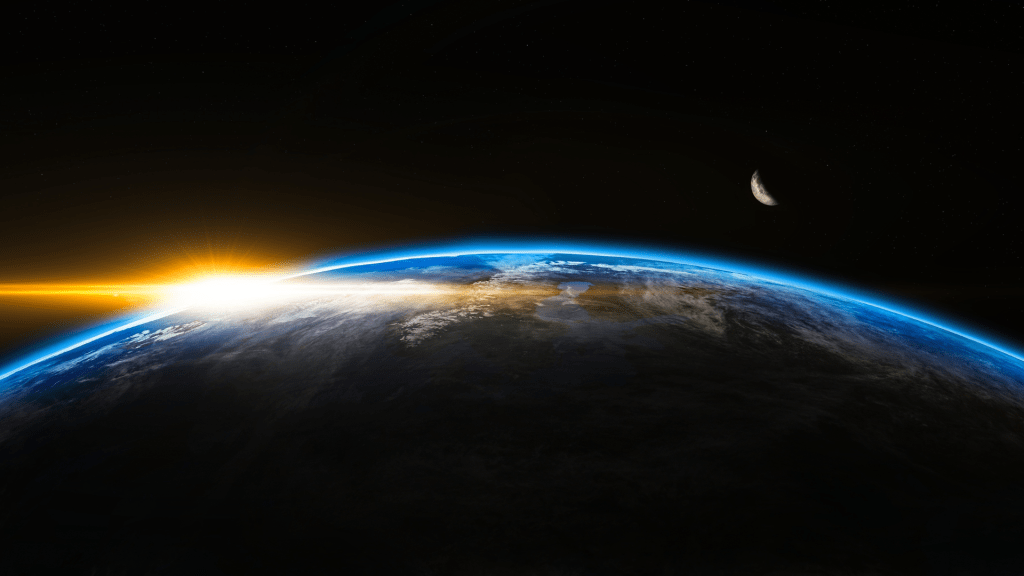
(Cover image by Qimono. Courtesy of Canva.)
 Jacob A. Davis